

 Join Aomar Karim’s Official Channel
Pakistan’s Balochistan has just witnessed one of the province’s deadliest ever episodes: a wave of attacks and clashes across several cities that left dozens of civilians, fighters, and security personnel dead, with official but unconfirmed tolls as high as 200 overall.
It marked the latest escalation in decades of conflict between separatist groups and the Pakistani state in Balochistan, where the central government has long been accused of exploiting rich resources while marginalising the local population.
But before the region came under the shadow of the recent violence, public attention was focused on the abduction of a young Baloch student, a case that has reignited simmering anger over enforced disappearances.
For more than 6,000 days, activists have maintained a protest camp outside the press club in Quetta, the capital of Balochistan province, demanding answers for hundreds of missing Baloch citizens who have been allegedly abducted, tortured, and killed by Pakistani security forces.
The history of these abductions, enforced disappearances, and extrajudicial executions targeting political activists, journalists, lawyers, and students dates back to the 1970s, but the July disappearance of a 24-year-old university student in Islamabad brought the longstanding issue back to the fore.
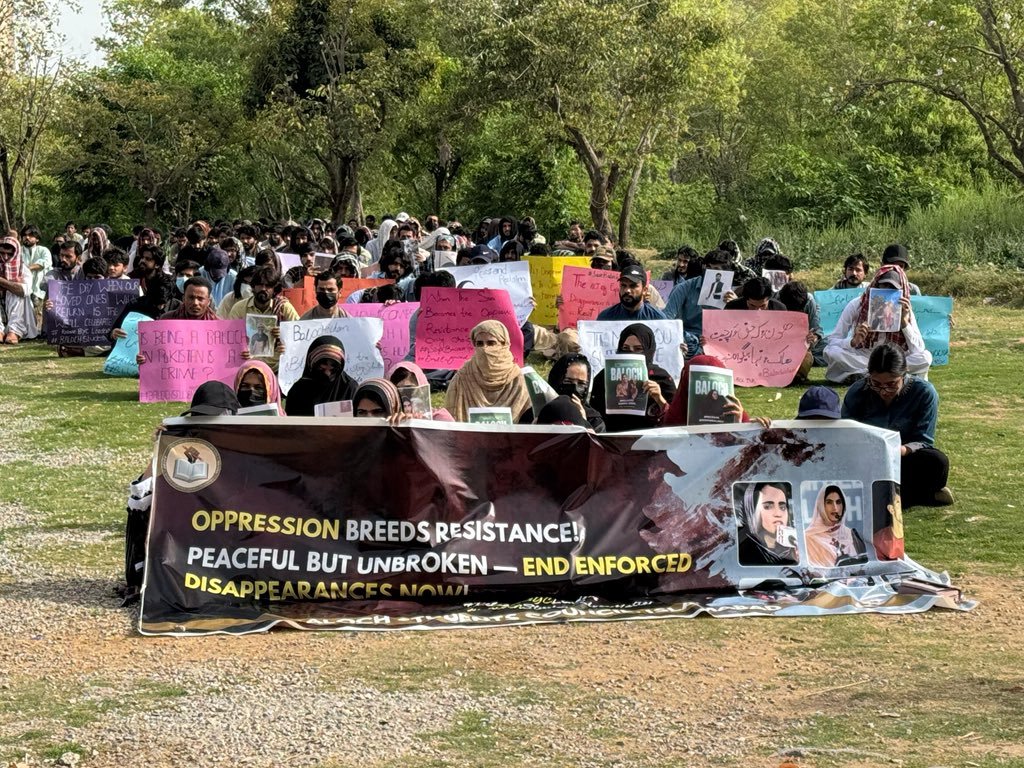
On 8 July, Saeed Baloch, a Defence and Strategic Studies student at Quaid-i-Azam University (QAU) was dragged off a bus in broad daylight. Saeed’s case moved to the centre of the national conversation after a second wave of student-led demonstrations at QAU in late November. The protesters are demanding an end to the racial profiling of Baloch students and to have the university conduct a transparent investigation into Saeed’s disappearance.
When The New Humanitarian visited the sit-in in November, classes had been suspended for more than a week as students from different ethnic backgrounds refused to disperse, huddling together on campus lawns and around small bonfires to keep warm.
Near one of those fires sat Azam Baloch, Saeed’s older brother, a constant presence at the protest gatherings. Azam has been pursuing the case through all available legal channels. He insists his brother had been “racially profiled and harassed on campus days before his abduction”.
“Saeed was questioned by unauthorised individuals posing as representatives of a private company within the premises of the Defence Strategic Studies department,” Azam said, adding that these interactions took place in the presence of a faculty member and that the same individuals later approached Saeed’s roommates in their dorms to inquire about him.
Jahanzaib Baloch, a fellow QAU student who was travelling with Saeed when he was apprehended, said the bus was intercepted on the 890-kilometre road from Islamabad to Balochistan.
“Men in plain clothes boarded the bus, confiscated everyone’s mobile phones, conducted an intensive search, and then dragged Saeed away,” he recalled. “They blindfolded him and whisked him away within seconds.”
A palpable fear hung over the protest camp – fear of being harassed by the security forces or of meeting a far worse fate. In the last five years alone, more than 10 Baloch students have been forcibly disappeared from Islamabad. Most were later released, but only after illegal detention, alleged physical torture, and mental harassment.
“This is not an isolated incident,” said a campus organiser, identified only as Chakar for security reasons. “It is a systemic strategy to harass Baloch students based on their identity, forcing them to abandon their education.”
To date, the university has not issued any statement regarding Saeed Baloch’s disappearance or the student demonstrations.
Decades of insurgency
Since the accession of Balochistan in 1948 – an event Baloch nationalists describe as annexation, but Islamabad regards as legal integration – what became Pakistan’s largest and most sparsely populated province has experienced a decades-long insurgency, driven by grievances over political autonomy, resource exploitation, and human rights abuses.
Relations between the Baloch and the Pakistani state have been marked by cycles of conflict and accusations of disenfranchisement. Activists in Balochistan have repeatedly demanded a greater share of the province’s oil and gas revenues, which they say disproportionately benefit other regions. This has led to a number of conflicts, with each wave of armed resistance met by military suppression.
The current phase of the insurgency – starting in the 2000s and led largely by educated, middle-class youth rather than traditional tribal leaders – has been marked by widespread enforced disappearances, according to Mohammad Ali Talpur, a Baloch writer who was part of the armed Balochi nationalist movement in the 1970s.
“Any state that wants to suppress the struggle for rights will target all sections of society,” he told The New Humanitarian. “As students and the educated have greater potential of awakening people, they are considered more of a threat… It is because of this that students are targeted.”
According to activists, around 7,000 people have been forcibly disappeared in Balochistan in the past 12 years. Victims are first identified as being Baloch, then targeted as a result of a specific social or political stance within their community.
One of the earliest known cases involved Asad Mengal, son of former Balochistan Chief Minister Attaullah Mengal, who was abducted in Karachi. More than four decades later, his fate remains unknown. During the 2000s, the practice continued. Thousands were abducted under the guise of counter-insurgency and national security. Bodies of the disappeared would later resurface in far-off locations, bearing signs of severe torture, a period Baloch activists describe as the “kill and dump” policy.
Prominent activists such as Ghulam Muhammad, Qambar Chakar, Ilyas Nizar, and Sangat Sana were killed. Others, including Zakir Majeed, Deen Muhammad, and Zahid Baloch, remain missing.
“As long as Baloch and Balochistan exist, this threat perception would translate into increasingly violent responses, which range from the abduction of men and women to the killing of Baloch people.”
“The very existence of the Baloch is perceived as a threat to the state,” said Sabiha Baloch, head of the Baloch Yakjehti Committee (BYC), a women-led organisation fighting rights abuses in Balochistan. “The more educated, conscious, and politically aware the Baloch become, the more threatened the state feels.”
The BYC itself came under state scrutiny following a 2023 march led by former head Mahrang Baloch, which went from Turbat to Islamabad to protest what organisers described as genocide. Upon reaching the capital, protesters faced police batons, water cannon, arrests, and accusations of being foreign-funded “extremists”. Last March, Mahrang Baloch was arrested during a protest in Quetta and is now facing charges of terrorism, violence, and anti-state activities.
“Pakistan’s economy remains deeply tied to the exploitation of Balochistan,” Sabiha added. “As long as Baloch and Balochistan exist, this threat perception would translate into increasingly violent responses, which range from the abduction of men and women to the killing of Baloch people.”
Lawyer and human rights defender Iman Mazari argues that the reason why Baloch students are systematically targeted is due to “a prevailing culture of impunity, in which those responsible for enforced disappearances are rarely held accountable.”
“This lack of accountability has emboldened state institutions,” she said.
This has been well documented across other minority groups, such as the Pashtuns and the Shia Hazaras, who have also faced extrajudicial killings, enforced disappearances, and collective punishment during security operations. Sectarian violence has also been documented against these groups, marked by mass attacks, forced segregation, and repeated failures to prosecute perpetrators.
Resistance is the only way forward
The disappearances are not limited to students pursuing higher education in the urban confines of the capital. On 31 August 2018, a family picnic in Nushki, Balochistan, became a lifelong wound for Saira Baloch. That day, her brother Asif and cousin Rasheed were disappeared.
“My body started shivering. I cried out. For the first time in my life, I saw my father break down in tears,” Saira recalled.
The family’s home in Khuzdar was filled with silence and grief, her mother bursting into tears and her sister reciting the Quran. The disappearance upended their lives, as Asif had been the family’s breadwinner, supporting their education and daily needs.
“Silence was a mistake,” Saira told The New Humanitarian in December. “If we had spoken earlier, maybe they would have been released. Nobody guided us. Nobody told us what to do.”
In June 2021, Saira found her voice by joining a protest in Quetta demanding the release of another disappeared activist. Witnessing police beatings for the first time, she initially refused to speak, but later told herself, “If I don’t speak for my brothers, who will?”
Since then, she has participated in prolonged protests in Islamabad, sitting for weeks on the streets to raise awareness of the thousands of Baloch families whose loved ones remain missing. Despite enduring profound loss, displacement, and poverty, her family refuses to surrender.
“Disappointment is not an option,” Saira said. “The state may not listen today, but this struggle will echo into the future. Maybe this struggle won’t bring back Asif and Rasheed, but if it saves another sister from living this pain, then it is worth it.”
Keeping their memories alive
In 2022, the Islamabad High Court ordered the establishment of a Commission to look into the grievances of Baloch students relating to racial profiling and enforced disappearances. The Commission submitted its report to the court the following year, and this drove some progress, with several students being recovered.
Unfortunately, in March 2025, the larger bench that had been constituted to hear missing persons cases became defunct after Justice Arbab Muhammad Tahir recused himself. Despite repeated requests and protests by families of the forcibly disappeared and Baloch students, the cases have still not been assigned to be heard.
There were some other small gains, though.
The students at QAU disbanded in early December after the Baloch Students Council announced the end of its sit-in at QAU. The council said one of their key demands – the submission of factual reports by QAU to the Islamabad High Court – had been met. In its statement, the council accused university officials of delay and harassment, vowed to continue their struggle against enforced disappearances, and warned they would escalate their movement if Saeed Baloch is not safely released.
“It is pertinent to remember that this is not the first documented case of racial profiling and enforced disappearance of a Baloch student from QAU,” Mazari told The New Humanitarian. “Similarly, Hafeez Baloch’s case was filed in the Islamabad High Court in 2022, and a Commission was established pursuant to the Court’s directions to inquire into the issue of racial profiling and enforced disappearances of Baloch students. Despite the recommendations by the Commission, the impunity continues.”
Organisations like the VBMP – founded by Mama Qadeer Baloch after the abduction and death of her son – have kept the fight alive for over a decade, marching, protesting, and demanding answers.
“The objective of this long and peaceful struggle is to see the country free from enforced disappearances,” Nasrullah Baloch, the group’s chairman, told The New Humanitarian. “VBMP demands are within the constitutional framework, which include the complete elimination of enforced disappearances and the extrajudicial killing of missing Baloch persons, and ensuring immediate practical steps for the recovery of missing individuals.”
For families of the forcibly disappeared, memory and protest have become inseparable. They describe how normal life has been replaced by an unending cycle of demonstrations, rallies, and sit-ins – carried out in the hope that public visibility might succeed where legal processes have failed.
“Every day, we remember the life we once lived, a life that was happy and full of warmth,” Saira Baloch said of the loss that has reshaped every aspect of her family’s existence. “This struggle is not only for them, but for every Baloch who has been forcibly disappeared.”
Azam Baloch agreed, saying that raising their voices in public spaces has become a necessity. “I do not want Saeed’s name to be forgotten,” he said. “Protest is the only way the family believes it can keep his memory alive and compel officials to acknowledge our demands.”
This article is published in collaboration with Egab. Edited by Ali M. Latifi and Andrew Gully.
Courtesy: https://www.thenewhumanitarian.org/

