
 Join Aomar Karim’s Official Channel
Balochistan, 13 April 2026 (Aomarkarim.com): In the space of just a few weeks, the bodies of seven men have been found discarded on roadsides and in open areas across Balochistan, Pakistan’s largest province. Each had been forcibly disappeared, some for as long as nine months, before their families received not a phone call or a court summons, but a corpse.
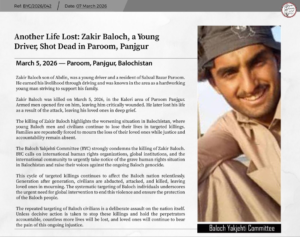
The cases have been documented by the Baloch Yakjehti Committee (BYC), a human rights organisation that has been raising the alarm over as a systematic campaign of enforced disappearances and extrajudicial killings targeting Baloch men, with a particular focus on students and young people.
The youngest victim was 17 years old.
Sadiq Noor, a student from Gelli Bahut Bazar in the Buleda district, was taken from his home in Absar, Turbat, at half past one in the afternoon on 7 September 2025. According to BYC, personnel from the Frontier Corps (FC) and Military Intelligence (MI) carried out the detention in broad daylight, in front of neighbours and family. For nearly five months, his relatives heard nothing. On 10 April this year, his body was found in the Kechkhoor area of Turbat. He had been held for four months and 28 days.
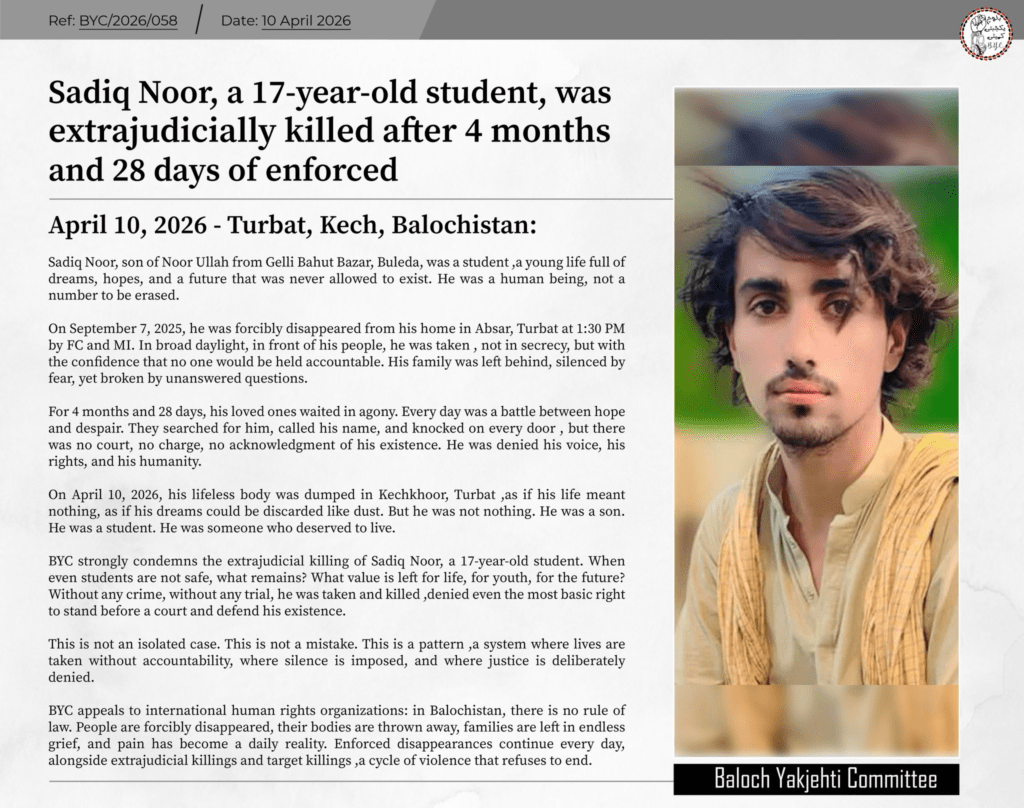
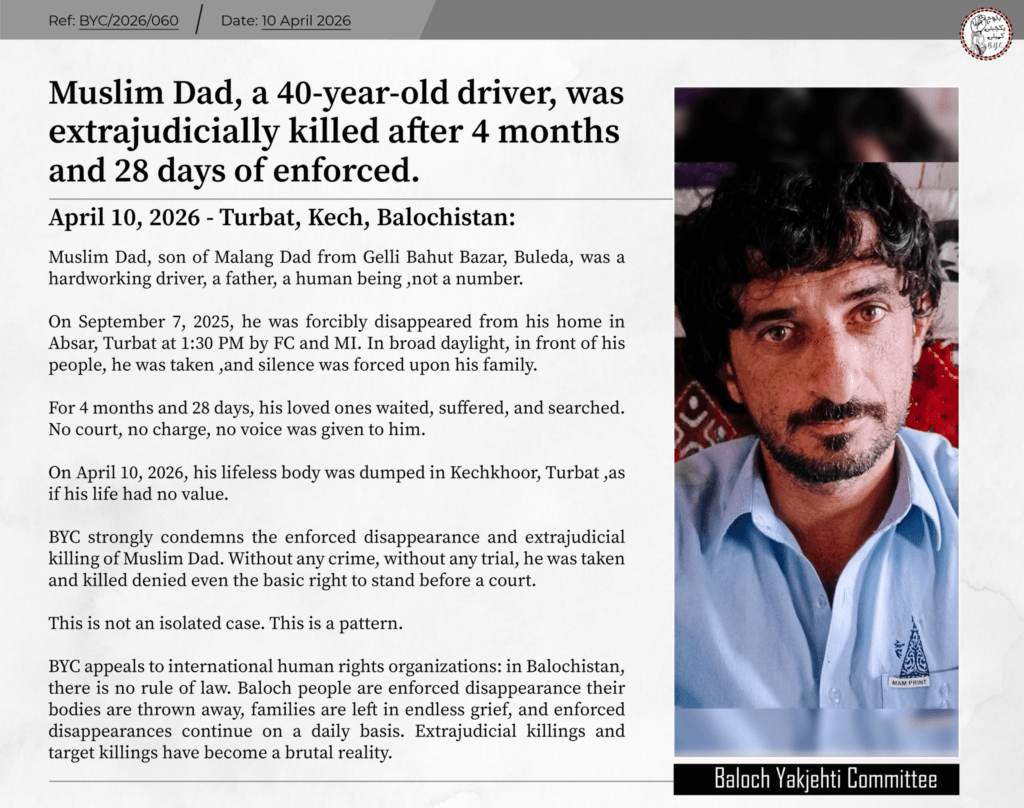
On the same day that Sadiq Noor’s remains were found, a second body was recovered from the same area. Muslim Dad, a 40-year-old driver and father from the same village, had been taken at the same time and from the same location as Sadiq. The two men, one a teenager and one a working father, had apparently been disappeared together.
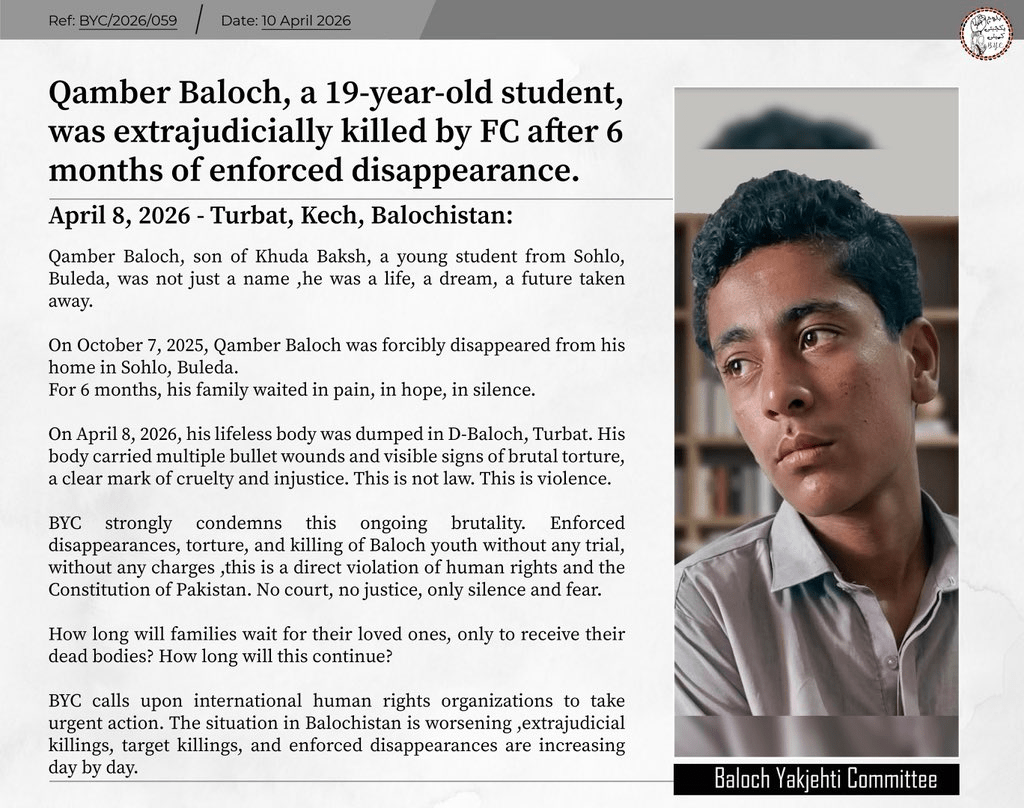
Two days earlier, on 8 April, the body of Qamber Baloch, a 19-year-old student from Sohlo in Buleda, was found in the D-Baloch area of Turbat. He had been forcibly taken from his home on 7 October 2025. BYC says his body bore multiple bullet wounds and visible signs of torture. He had been missing for six months.
The accounts stretch back further. On 26 March, the family of Yarwar Baloch, an 18-year-old tailor from Humari Kahn in Shapuk, received news that his body had been found on Pasni Road. He had been shot in the head. Yarwar had disappeared nine months earlier, on 16 June 2025, snatched from outside the High Court where he had attended a hearing with his father. The cruelty of the timing, taken at the gates of a court of law, was not lost on those who witnessed it.
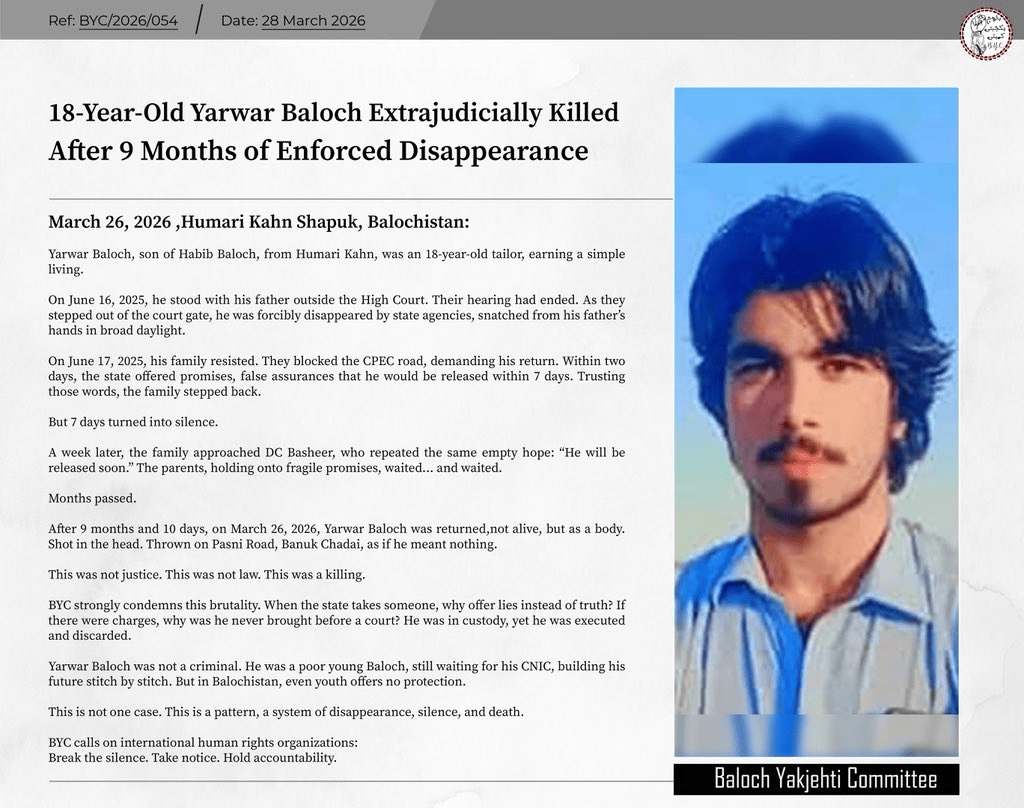
His family had not remained silent. They blocked the CPEC road in protest, demanding his return. State officials, including the district commissioner, offered assurances: he would be released within seven days. He was not. The promises dissolved into silence, and the silence lasted nine months.
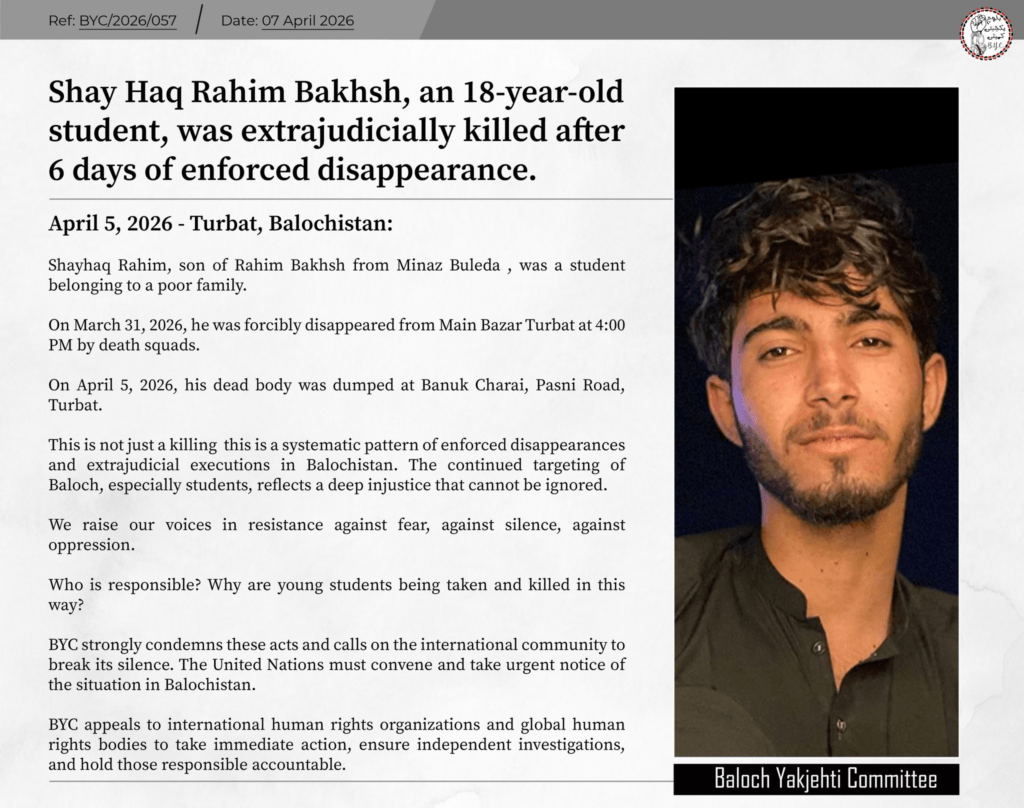
On 5 April, the body of Shayhaq Rahim, an 18-year-old student from Minaz, Buleda, was found dumped at Banuk Charai on the Pasni Road in Turbat. He had been taken from the main bazaar just six days earlier, on 31 March.
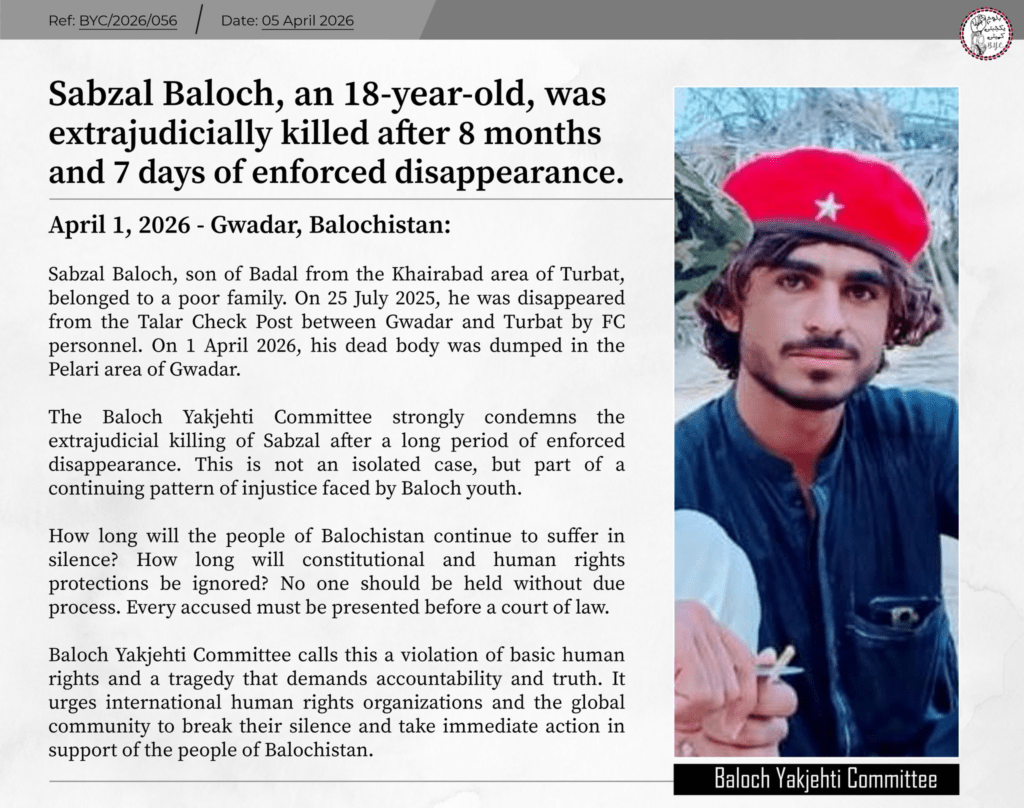
In Gwadar, two further cases emerged at the start of the month. Sabzal Baloch, also 18, had been detained at the Talar checkpoint between Gwadar and Turbat on 25 July 2025 by FC personnel. His body was found in the Pelari area of Gwadar on 1 April, more than eight months after he was taken.
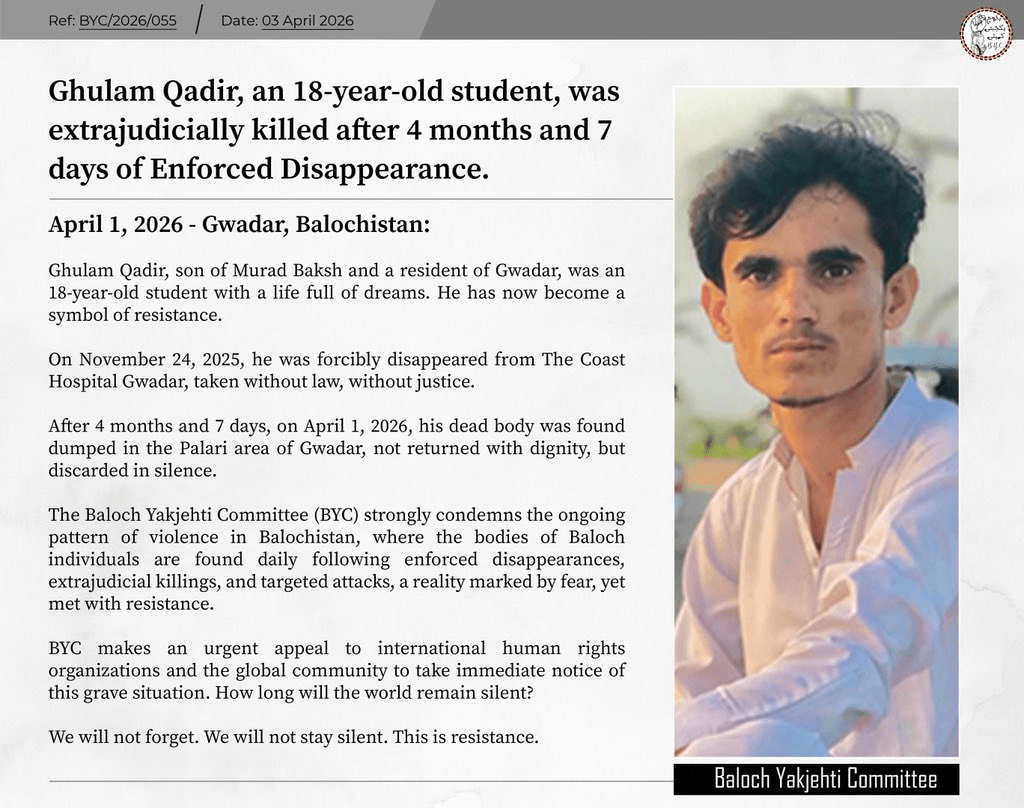
On that same date, the body of Ghulam Qadir, an 18-year-old student from Gwadar, was found in the same area. He had been disappeared from the Coast Hospital in Gwadar on 24 November 2025, while apparently seeking or accompanying someone for medical care.
Across these seven cases, the pattern is strikingly consistent: men taken without warning, without charge, without legal process; families left waiting in the dark; and bodies eventually returned not through any formal notification, but simply found and identified.
BYC has called on international human rights bodies, including the United Nations, to take urgent notice of the situation. “In Balochistan, there is no rule of law,” the organisation said in one of its statements. “People are forcibly disappeared, their bodies are thrown away, families are left in endless grief.”
Pakistan’s military and government have long denied involvement in enforced disappearances in Balochistan, and the FC has not publicly responded to these specific allegations. The Pakistani government has repeatedly characterised security operations in the province as counter-insurgency measures against armed separatist groups. Balochistan has experienced a low-level but persistent insurgency for decades, and the region has largely been off-limits to independent journalists and investigators, making independent verification of individual cases extremely difficult.
Human rights organisations, including Amnesty International and Human Rights Watch, have for years documented enforced disappearances in Balochistan, and the United Nations Working Group on Enforced or Involuntary Disappearances has repeatedly raised the issue with Islamabad. Pakistan has consistently urged the families of the missing to pursue redress through domestic courts, though BYC and other activists argue that those courts have proven ineffective when security forces are implicated.
What these seven cases share, beyond the manner of their deaths, is youth. Five of the seven were teenagers or barely out of their teens. Several were students. One was still waiting for his national identity card. Another was taken from the steps of a courthouse. None, according to BYC, was ever charged with any offence or brought before a judge.
“He was a son. He was a student. He was someone who deserved to live,” BYC wrote of Sadiq Noor. The same words, with different names, could apply to all of them.